
#001
Zyber 8G Premium: a real-world review
Frost-cold ASICs, solid 10 TH/s performance and a support resolution that deserves respect.
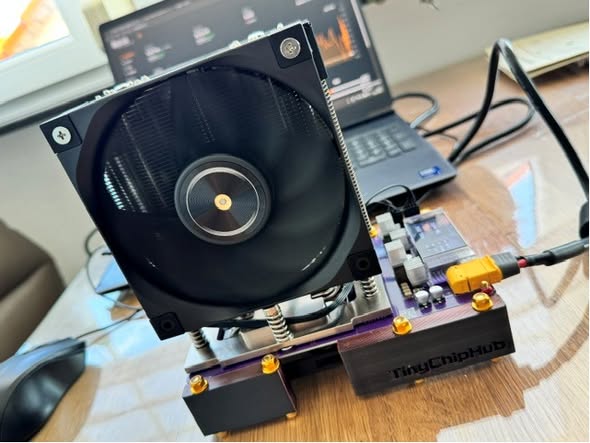
Transparency: This review is based on my private home/solo mining setup. This is not paid advertising. The new miner and the upgraded cooling unit were provided to me as part of a joint solution with TinyChipHub.
This article records my experience at the time of the original Facebook post. Measurements, firmware behaviour and the quoted price describe that test, rather than the current product or shop offer.
From overheating to a generous solution
It took some time until we found a fully satisfactory solution together. The background was overheating and stability issues with my original Zyber 8G standard version. In the end, however, TinyChipHub did much more than I could realistically have expected: they sent me a completely new Zyber 8G and, in addition, an improved Premium cooling unit for my original Zyber 8G.
At this point, I would like to say thank you again to the TinyChipHub team. This kind of solution is not something you can take for granted.
My setup: real home/solo mining with my own node
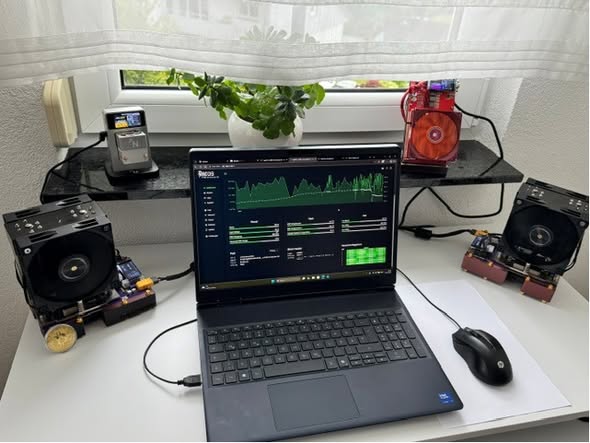
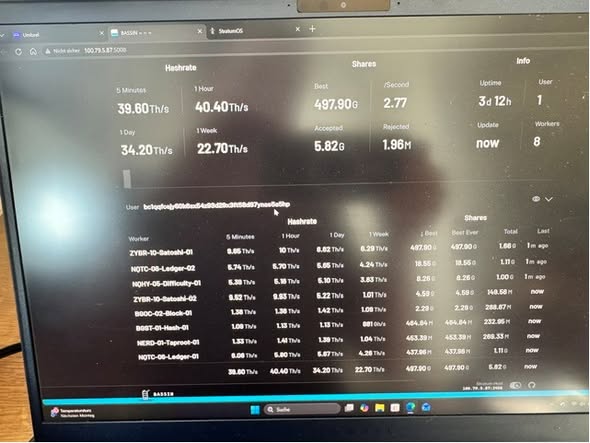
I do not simply point my miners to an external pool. I run my own small home/solo mining setup: an Umbrel node with a 4 TB SSD, Bassin Pool (CKPool) on Umbrel as the main pool, and 5tratumOS on a Raspberry Pi 5 as the fallback pool. Several home miners run in parallel, with approximately 40 TH/s combined. I monitor them through HashWatcher and the individual AxeOS/miner dashboards.
I name my miners according to a fixed system: device abbreviation – TH class – name – running number. Examples are ZYBR-10-Satoshi-01, ZYBR-10-Satoshi-02, NQTC-06-Ledger-01, NQHY-05-Difficulty-01 and BGOC-02-Block-01. This keeps the setup easy to understand, even with several devices running at the same time.
Unboxing, appearance and first impression
The Zyber 8G with the Premium cooling unit immediately feels much more serious when unpacking it than many other home miners. The unit is bulky, solid and has a very technical, almost industrial look thanks to the large tower cooler. You can immediately tell: this is not a small toy miner, but a serious desktop miner.
Visually, the Zyber 8G is one of the highlights on my desk. The combination of the open board, large tower cooler, clean wiring and the TinyChipHub base looks excellent. In terms of design, I think TinyChipHub sets its own standard here. The miner does not just look like technology – it looks like Bitcoin.
Factory settings and the original problem
The factory settings were 600 MHz ASIC frequency, 1.15 V core voltage, automatic fan control, a 60 °C target temperature and 40% minimum fan speed.
With my original standard version, this was exactly where the problems started. I had to underclock the miner to around 525 MHz so that it would run somewhat stable. The standard cooling solution did not handle the heat convincingly on my unit. With the Premium cooling unit, the situation is completely different. After the upgrade, the ASIC temperatures were already only around 31 to 34 °C at 40% fan speed. There is hardly any other way to put it: these things run seriously cold.
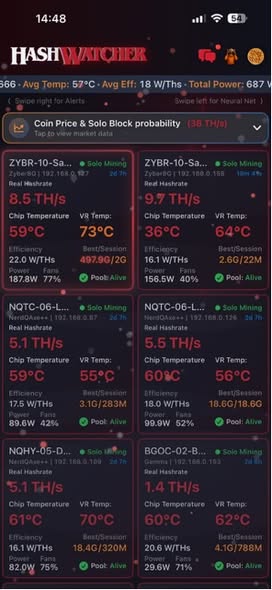
Two Zyber 8G miners running side by side
I tested both devices side by side. ZYBR-10-Satoshi-01 is my original Zyber 8G, upgraded with the new Premium cooling unit and a very thin layer of Arctic MX-7 thermal paste on the ASICs. ZYBR-10-Satoshi-02 is the newly delivered TinyChipHub unit with Premium cooling.
Both miners used the same settings: 625 MHz ASIC frequency, 1.15 V core voltage, automatic fan control and 40% minimum fan speed. Both units were therefore slightly overclocked compared with their factory settings, while still running very comfortably.
Recorded test results
| Metric | ZYBR-10-Satoshi-01 | ZYBR-10-Satoshi-02 |
|---|---|---|
| Hashrate | 10.2 TH/s | 10.1 TH/s |
| Efficiency | 16.31 J/TH | 15.88 J/TH |
| Power consumption | 166.1 W | 160 W |
| Input voltage | 12.2 V | 12.1 V |
| ASIC frequency | 625 MHz | 625 MHz |
| Measured ASIC voltage | 1.15 V | 1.15 V |
| ASIC temperature 1 | 34.1 °C | 37 °C |
| ASIC temperature 2 | 43.8 °C | 43 °C |
| Voltage regulator temperature | 65 °C | 65 °C |
| Fan speed | 40 % | 40 % |
| Fan 1 / Fan 2 | 943 / 832 RPM | 915 / 821 RPM |
For a 10 TH/s desktop miner, these are really strong numbers. The ASICs are running extremely cool. The limiting factor is clearly not the chip temperature, but the voltage regulator area.
The new miner was slightly more efficient, while the upgraded original unit with the additional Arctic MX-7 thermal paste showed slightly lower ASIC temperatures. This extra step is probably not necessary, but the comparison is still interesting.
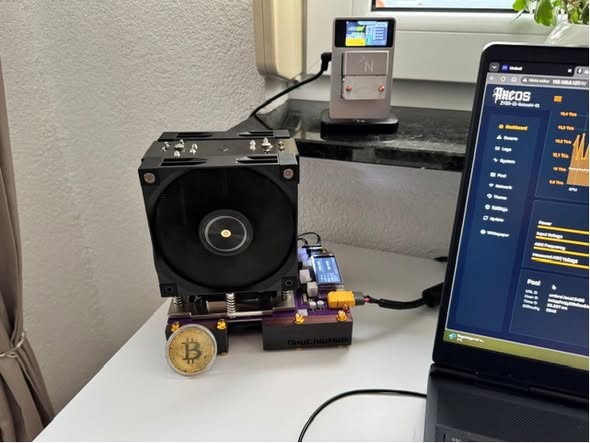
The Zyber 8G does not look like just another DIY device, but like a high-quality desktop miner that visually fits into a home office setup. After installing the Premium cooling unit, my HashWatcher overview showed around 41 TH/s combined hashrate at approximately 669 W total power consumption.
What stands out during operation?
The biggest difference compared with the standard version is the thermal headroom. The ASICs on both Premium units are almost running too cold. Temperatures between 34 and 43 °C at around 10 TH/s are impressive for a compact home miner.
In my opinion, the actual bottleneck is the VREG area. On both devices, the voltage regulator temperature was around 64 to 65 °C. That was still acceptable in my test, but it shows where I would focus before trying to push performance further: improved cooling for the voltage regulators or, in the future, a possible MOSFET/VREG upgrade. The ASIC cooling is already excellent.
Purely from the cooling capacity, 12 TH/s did not seem unrealistic to me. That was an estimate, not a measured result; whether it makes sense for long-term daily operation is a different question. For me, around 10 TH/s felt like the sweet spot: strong, cool, stable and efficient.
Comparison and personal classification
In my opinion, the Zyber 8G Premium is on the same level as the NerdOCTaxe in the range of around 9.6 TH/s, and perhaps ahead in some areas. Considering price, appearance, cooling concept and desktop suitability, the Zyber 8G Premium is a very strong overall package. This is my personal assessment, rather than a controlled benchmark comparison.
In the original review I quoted a TinyChipHub price of EUR 552.95 for the Premium version. At that price, I considered it an attractive offer for technically solid and visually impressive home/solo mining. This is a historical price reference, not a current price claim.
Final verdict
If you buy a Zyber 8G, get the Premium version. After my initially difficult experience with the standard version, my verdict from this test is very clear: the Zyber 8G Premium is a home miner I can recommend. Both tested units ran stable, cool and convincingly at around 10 TH/s. The visual design is excellent, the build feels solid and the performance numbers speak for themselves.
The standard version was not thermally convincing in my case. The Premium cooling unit completely changed the miner. What started as a problematic unit became a very strong, cool and stable desktop miner.
The support deserves a fair mention too: it took some time, but TinyChipHub did not merely solve the issue. They responded generously and in a customer-oriented way. A new miner plus a Premium cooling unit for the original device was more than I expected.
Zyber 8G Premium: a clear recommendation from my test. Excellent design, very strong cooling and around 10 TH/s performance. There may be further potential if the VREG area is improved, but I did not establish that in a long-term test. For home/solo mining, it is a beautiful piece of Bitcoin hardware.